Example 1: Founding of a cellulosic-feedstock-derived biofuel company that has unique co-product technology.
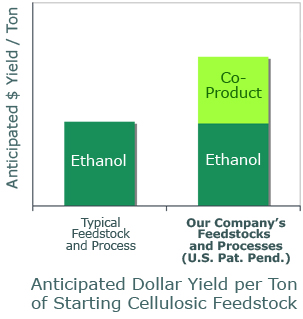
OBJECTIVES: Today, cellulosic-feedstock-derived ethanol production in the United States generates only enough fuel to supplement the U.S. gasoline market by a few hours per year. The United States Energy Independence and Security Act (EISA), signed into law in 2007, mandates that U.S. cellulosic ethanol production be at ~34 times today's levels less than 10 years from now, generating more ethanol per year than was produced from corn in the U.S. in 2007. The value of this ethanol will be ~$18 billion per year in today's dollars. Current enzyme/fermentation methods for producing ethanol from lignocellulosic feedstocks generate approximately twice as much low-value waste material as biofuel. This low-value waste accounts for nearly half the weight of the starting biomass. In contrast, we have defined a cellulosic-feedstock-derived biofuel technology that, once developed, holds the potential of replacing a large percentage of this waste with a co-product that we anticipate will have a monetary value approaching that of the biofuel.
EXECUTION: The defined technology roadmap for generating both cellulosic-feedstock-derived biofuel and the high value co-product has been protected by provisional and non-provisional U.S. patent filings. Our company's Intellectual Property Law Firm is one of the largest in Canada, and has as its clientele major multi-national companies in the fields of Wireless Telecom, Pharma, Finance and Agriculture.
RESULTS: Development of this company and its technology is on-going.




 EXECUTION: