
Example 4: Under sub-contract to
Corning Inc., the development of a new ceramic material for aerospace applications.
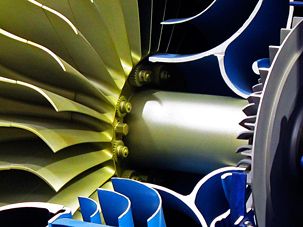
OBJECTIVES: Under sub-contract to a project funded by the United States Office of Naval Research (ONR) and the U.S. Defense Advanced Research Projects Agency (DARPA), we were assigned the development of a new low-friction ceramic material with high thermal stability for possible use in jet engines. The goal was to significantly increase the thermal stability of the low-friction mineral talc, Mg3Si4O10(OH)2, through fluoride-substitution.
EXECUTION: We developed a unique synthesis route employing sol-gel techniques for synthesizing the new ceramic material, fluoride-substituted talc, Mg3Si4O10(OH1-XFX)2, achieving fluoride substitution as high as 75%, which currently stands as a world record.
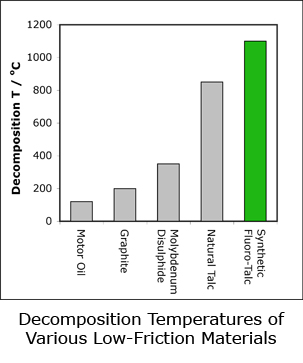
RESULTS: Using DTA/TGA methods in conjunction with powder XRD and FTIR techniques, we demonstrated that the thermal stability of talc increased from 850 oC (red visible surface emission) for natural hydroxy talc to approx. 1100 oC (white visible surface emission) for talc with 75% fluoride substitution.
A.A. Rywak et al. ”The Crystal Chemistry and Thermal Stability of Sol-Gel Prepared Fluoride Substituted Talc“ Phys. Chem. Minerals. 1996, 23, 418-431